
Archbishop of Canterbury revokes award to Pakistani cleric after bin Laden remarks resurface
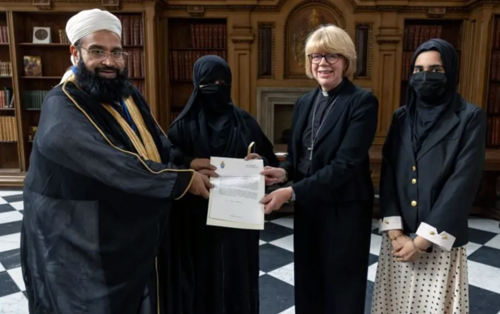
The Archbishop of Canterbury has withdrawn an interfaith award given to Pakistani Muslim cleric Hafiz Muhammad Tahir Mehmood Ashrafi after past remarks praising Osama bin Laden resurfaced, raising questions in Pakistan about why he was recommended for the honor by Church of Pakistan’s Moderator Bishop Azad Marshall.
Ashrafi received the Hubert Walter Award for Reconciliation and Interfaith Cooperation 2026 from Archbishop of Canterbury Dame Sarah Mullally at Lambeth Palace in London on Sept. 11, the 25th anniversary of the terrorist attacks in the United States. Lambeth Palace announced Sept. 17 that the award had been withdrawn after previous comments by Ashrafi came to light.
Marshall, Bishop of Raiwind Diocese and moderator/president bishop of the Church of Pakistan, said in a congratulatory letter to Ashrafi that he had “personally recommended his name” for the award during the visit to Pakistan of former Archbishop of Canterbury Justin Welby.
“I had the privilege of personally recommending your name in recognition of your sustained and courageous services to peace and interfaith harmony,” Marshall wrote.
The letter, posted on the official Facebook page of the Church of Pakistan, praised Ashrafi for his “decades-long commitment to peace, reconciliation, moderation, interfaith and intra-faith harmony, the rights of religious minorities, and peaceful coexistence.”
It also praised his opposition to extremism, terrorism and sectarian violence and described the award as a source of pride for Pakistan and those working for religious harmony.
The Church of Pakistan’s spokesperson, the Rev. Emmanuel Khokhar, did not respond to Christian Daily International’s requests for comment on the withdrawal of the award or questions about Marshall’s recommendation.
Marshall is a controversial figure within the Church of Pakistan, and his recommendation of Ashrafi has drawn criticism from both Muslim and Christian Pakistanis following the withdrawal of the award.
Critics have questioned why Ashrafi was nominated despite his publicly documented positions concerning the minority Ahmadiyya community and his association with figures involved in blasphemy cases.
“I’m relieved that Tahir Ashrafi’s ‘interfaith harmony’ award has been withdrawn by Lambeth Palace. This was an insult to the victims of the Blasphemy Business Gang and the family of Abdullah Shah. The Archbishop of Canterbury was tricked into awarding a non-deserving recipient,” wrote Muslim commentator Muneeb Qadir on Facebook.
Christian activist Faraz Pervaiz also criticized Marshall, writing that the award had been withdrawn after Ashrafi’s previous remarks about bin Laden came to light and questioning why Marshall and others had continued to honor him.
Gerald Vincent, a London-based member of the Church of Pakistan, said the withdrawal raised questions about what due diligence had been undertaken before Ashrafi was recommended.
“Nevertheless, Bishop Azad’s own letter confirms his personal role in recommending Ashrafi,” Vincent said. “That makes his judgement in doing so a legitimate matter for public scrutiny.”
Ashrafi has publicly supported Pakistan’s constitutional restrictions on Ahmadis. In 2018, he was reported as calling for restrictions on Ahmadi literature and an Ahmadi translation of the Quran.
His brother, Hassan Muawiya, has also been involved in cases against Ahmadis under Pakistan’s blasphemy and anti-Ahmadi laws. A 2021 human rights report documented his role in pursuing such cases. More recent investigative reporting has alleged that Muawiya was associated with a network accused of exploiting blasphemy laws. Those allegations have not been established by a court.
Ashrafi has also publicly defended Pakistan’s blasphemy laws, arguing that they prevent people from taking the law into their own hands. In a 2014 statement reported by Dawn newspaper, he said the law should remain in place while those making false accusations should be punished.
At the same time, Ashrafi has intervened in cases involving religious minorities and publicly condemned violence against Christians and other non-Muslims.
The immediate controversy over the Lambeth award concerns comments Ashrafi made in 2007 following the British knighthood awarded to author Salman Rushdie.
Media reports quoted Ashrafi as saying that the Pakistan Ulema Council would honor bin Laden with the title “Saifullah”, meaning “Sword of God.” He described bin Laden as a “mujahid” (holy warrior) who had fought for Islam against Russians, Americans and Britons.
Ashrafi has subsequently said the remarks were “totally taken out of context” and were made in response to anger among Muslims over Rushdie’s knighthood. His representatives said the comments were not an endorsement of bin Laden or terrorism.
Bin Laden founded al-Qaeda, which carried out the Sept. 11, 2001, attacks in the United States, killing nearly 3,000 people.
Lambeth Palace initially honored Ashrafi for what it described as his “outstanding work as an ambassador of interfaith harmony in Pakistan” and his longstanding support for religious minorities, particularly Christians.
After the historical comments became public, however, the palace said it had reconsidered the award.
“It is a longstanding principle of interfaith dialogue and co-operation that we must engage with one another across deeply-held differences, and that remains the case,” Lambeth Palace said. “However, previous comments made by Imam Ashrafi have come to light that have led Lambeth Palace to reconsider this award and we can now confirm today that the award has been withdrawn.”
The original Lambeth citation highlighted Ashrafi’s intervention in the 2012 case of Rimsha Masih, a young Christian girl who was accused of blasphemy and imprisoned.
Ashrafi publicly described Rimsha as a “daughter of the nation” and condemned efforts to incite hostility against Christians. The case later collapsed after a Muslim cleric was accused of planting evidence against her.
The withdrawal of the award has now prompted significant questions not only about Lambeth Palace’s vetting process but also about the "personal recommendation" made by the moderator of the Church of Pakistan, Bishop Azad Marshall.


